
Small Business SEO Services: The Complete Guide (2026)
You know you need SEO. You've seen the "SEO services for small business" search results. But most of what comes up either gives you a price list without explaining what's included, or pitches you on packages that sound impressive but don't tell you what's actually going to move the needle for your business.
This guide covers what professional SEO services actually include, what you should pay at each level, how to tell a real agency from a box-checking operation, and how the right approach differs by industry. No fluff, just the information you need to make a good decision.

What "SEO Services" Actually Means for a Small Business
SEO isn't one thing. It's six distinct workstreams, and most agencies don't do all of them well. Understanding what each involves helps you evaluate what you're actually buying.
1. The SEO Audit
Every engagement should start with an audit. Before anyone changes anything on your site or GBP, a baseline needs to be established: where you rank now, what your competitors are doing, which technical issues are suppressing your rankings, and which keyword opportunities exist in your market.
A real audit covers 200+ factors across technical health, on-page optimization, GBP completeness, citation accuracy, and backlink profile. Agencies that skip this and jump straight to "link building packages" are guessing. Our local SEO audit establishes this baseline before we touch anything.
2. Google Business Profile Optimization
For most small businesses, the Google Business Profile does more work than the website. When someone searches "dentist near me" from their phone, the Map Pack appears before any organic results. If your GBP isn't optimized, you're invisible for the highest-intent searches.
GBP optimization includes: category and attribute accuracy, photo strategy, Q&A coverage, review velocity building, posting schedule, and hours and NAP consistency. According to BrightLocal's Local Consumer Review Survey, 98% of consumers read online reviews for local businesses, and review signals directly affect Map Pack rankings.
3. Local Citation Cleanup
Citations are listings of your business name, address, and phone number (NAP) across directories: Yelp, YellowPages, Apple Maps, Bing Places, industry directories, and dozens more. When your NAP is inconsistent across these platforms, Google's confidence in your business location drops, which suppresses local rankings.
Cleanup means auditing 40-80 directory listings, correcting inconsistencies, and suppressing duplicate listings. It's tedious work that most business owners don't have time for, but citation consistency is one of the fastest local ranking improvements available.
4. Content Creation
Rankings come from content. Your homepage can't rank for every service you offer and every city you serve. Each primary service needs a dedicated page. Each city or neighborhood you target needs location-specific content. Each question your customers ask before hiring you is a keyword opportunity.
Good content creation for local businesses means: service pages optimized for specific local keywords, blog posts targeting informational queries (like this one), and location pages for each city or neighborhood you serve. Generic content that could have been written about any business in any city doesn't rank.
5. Technical SEO
Technical issues can nullify everything else. If Google can't crawl your site, your content doesn't exist. If your pages load in 4 seconds on mobile, you're losing rankings and conversions simultaneously. Technical SEO covers: crawlability and indexing, page speed and Core Web Vitals, mobile optimization, structured data and schema markup, and canonical URL management.
If your site has fundamental structural problems, a content strategy alone won't fix it. Sometimes the right call is a complete rebuild, with SEO baked in from the foundation. Our website building service handles this at a fixed $2,988 one-time cost.
6. Reporting and Analytics
Good agencies tell you what's working and what isn't every month. Reporting should cover: keyword ranking changes (where you moved up, where you dropped), organic traffic trends from Google Analytics, GBP performance (views, calls, direction requests), and what work was done and what's planned next.
If your agency sends you a PDF of metrics without explaining what they mean or what actions they're taking, that's a box-checking operation, not a real SEO partner.
SEO Pricing: What Each Tier Actually Buys You
Pricing varies widely. Here's what you should realistically expect at each level:
$0-300/month: DIY or Bare Minimum
At this price point, you're either doing it yourself or paying for a tool subscription (SEMrush, Moz, etc.). No agency can do meaningful local SEO for under $300/month, the cost of the tools and data alone eats most of that. At this tier: claim and complete your GBP yourself, ask every customer for a Google review, and make sure your NAP is consistent across the main directories (Google, Yelp, Apple Maps, Bing).
$300-600/month: Entry Level
Enough to cover GBP optimization, basic citation cleanup, and some on-page fixes. Don't expect content creation at this tier. Best for: businesses in low-competition markets (small towns, niche industries) where GBP alone can produce meaningful results. In competitive Bay Area markets, this tier is a starting point, not a destination.
$600-1,000/month: Growth Tier
The right range for most competitive local markets. At this level, an agency can run ongoing GBP management, citation monitoring, 2-4 content pieces per month, and basic technical maintenance. This is where you start building durable ranking signals rather than just optimizing what already exists. Our Growth plan at $788/month covers this tier.
$1,000-2,000/month: Authority Level
Multi-location businesses, high-competition verticals (legal, medical, real estate in SF), and businesses targeting multiple cities need this range. Adds link building, aggressive content production (8-12 pieces/month), and multi-location GBP management. Our Authority plan at $1,288/month covers this scope.
$2,000+/month: Enterprise
National campaigns, franchise operations, and businesses with complex multi-site SEO needs. Not relevant for most small businesses.
How to Evaluate an SEO Agency: Green Flags and Red Flags
Green Flags
- Starts with an audit. No legitimate agency should propose a strategy before understanding your current situation.
- Sets realistic timelines. Anyone promising results in 30 days is lying. Local SEO takes 3-6 months for meaningful ranking improvements.
- Explains what they're doing. You should understand the strategy, not just receive a monthly invoice.
- Has industry experience. An agency that has worked with restaurants, law firms, and medical practices understands the different ranking dynamics for each.
- Provides transparent reporting. Monthly reports with actual data, not vanity metrics.
Red Flags
- Ranking guarantees. No agency can guarantee specific Google rankings. Google's algorithm is not for sale.
- Focus only on backlinks. Link building matters, but an agency that leads with "we'll build 100 backlinks per month" without discussing technical issues or GBP is selling you on the flashiest piece while ignoring the foundation.
- No contract transparency. Month-to-month contracts sound appealing, but they also mean the agency has no obligation to deliver long-term results. Commitment-based contracts with clear deliverables are a better sign.
- Immediate action without strategy. If an agency wants to start publishing content before auditing your site and competitors, they're filling time, not executing a strategy.
- Suspiciously low pricing. Under $400/month for a competitive market means the work is being outsourced to contractors using generic templates. You won't get local expertise at that price.
SEO by Industry: What Changes, What Doesn't
The six components above apply to every business. What changes is the emphasis, the competitive landscape, and the specific keyword strategy.
Restaurants
Restaurant SEO is 80% about the Local Pack. When someone searches "restaurants near me" they're making a decision in the next 30 minutes. Map Pack position 1 vs. 3 determines whether they walk through your door. GBP photo strategy (restaurants with 100+ photos get dramatically more calls) and review velocity are the highest-impact levers. See our dedicated Restaurant SEO page for the full breakdown.
Healthcare (Doctors, Dentists, Medical Spas)
Healthcare falls under Google's YMYL (Your Money or Your Life) category, which means Google holds these sites to a higher authority standard. E-E-A-T signals (Experience, Expertise, Authoritativeness, Trustworthiness) are essential: credentials displayed on every provider page, peer citations in content, and structured data that communicates professional qualifications. Our healthcare SEO approach covers doctors, dentists, and medical spas separately because each vertical has different keyword patterns.
Legal
Legal SEO has the highest CPCs in any local market, which makes organic ranking the most financially significant win. A personal injury attorney who ranks organically for primary keywords can replace $10,000-30,000 per month in Google Ads spend. Competition is fierce and timelines are long (6-12 months for competitive terms), but the ROI math is compelling. See our legal SEO and personal injury lawyer SEO pages.
Professional Services (Accountants, Consultants, Financial Advisors)
Professional services have strong seasonal patterns. Accounting firms get 60% of their annual new client inquiries between January and April. Financial advisors see spikes around market volatility events. Content strategy needs to align with search seasonality, not just evergreen keywords. See our Accountant SEO page for the CPA-specific approach.
Real Estate
Real estate SEO requires competing with Zillow, Realtor.com, and Redfin for listing pages, which is a losing battle. The winning strategy focuses on neighborhood guides, market reports, and local expertise content that the portals can't replicate at scale. See our realtor SEO breakdown.
Home Services (Roofing, Plumbing, Pest Control)
Home services SEO is often emergency-driven: someone's pipe burst, they need a roofer today, there are bugs in the kitchen. High-intent, same-day conversion searches. Local Pack dominance is critical because few people search past the top 3 results when they have an urgent need. Our home services SEO approach covers roofing, plumbing, and pest control separately.
DIY vs. Agency: When Each Makes Sense
Start DIY if:
- You're pre-revenue and learning the market
- You're in a genuinely low-competition niche where basic GBP optimization alone can produce results
- You have time to learn and execute (10-15 hours per month minimum)
Hire an agency when:
- Your time is worth more than the retainer cost (if you bill $150/hour, 5 hours of your time = $750 per month in opportunity cost)
- You're in a competitive market where DIY fundamentals won't move the needle
- You want to build a durable ranking position, not just maintain the basics
- Your competitors are investing in SEO and you're falling behind
How Long Does SEO Take?
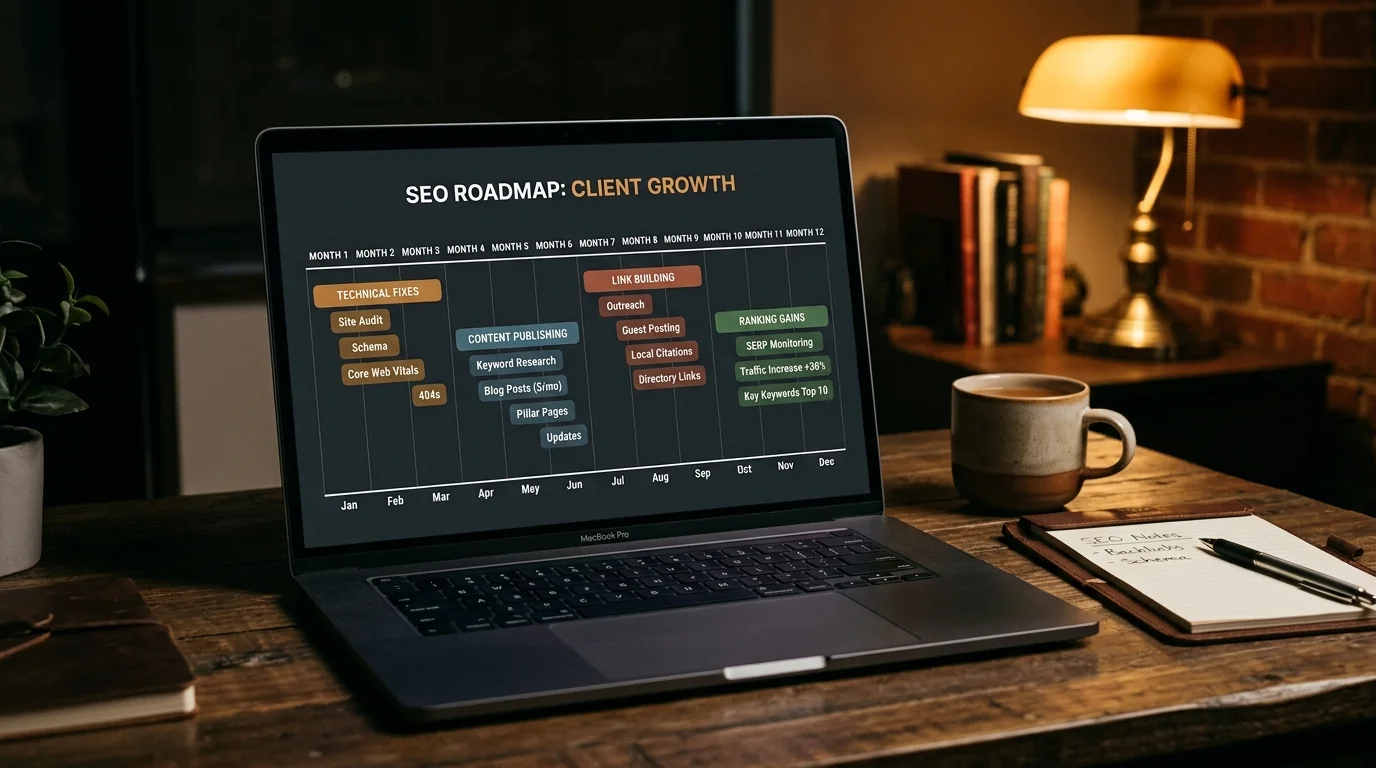
GBP optimization typically shows ranking movement in 4-8 weeks. New content pages take 2-4 months to rank. Competitive keyword rankings take 3-6 months in most local markets and 6-12 months in highly competitive verticals like legal and medical. For a complete timeline breakdown by SEO type and industry, see our guide on how long SEO takes.
AI Search is Changing How Customers Find You
An increasing number of searches now happen through ChatGPT, Perplexity, and Google's AI Overviews. These tools pull from authoritative web content, not just Google rankings. A business that appears in AI-generated answers gets discovery that doesn't show up in traditional analytics. This is a new layer of SEO that sits on top of traditional search, and the optimization principles are different. Our guide on how to rank in AI search covers what actually matters for AI engine visibility.
Sources and References
- Google. (2025). Creating Helpful Content. developers.google.com
- Google. (2025). SEO Starter Guide. developers.google.com
- BrightLocal. (2025). Local Consumer Review Survey. brightlocal.com
- Whitespark. (2025). Local Search Ranking Factors. whitespark.ca
Voxel Phase provides local SEO audits, content strategy, and SEO-optimized websites for small businesses in San Francisco, Oakland, the Bay Area, San Jose, and Sacramento. Plans start at $588/month. Get your free SEO audit and we'll show you exactly where you stand and what to fix first.