
SEO for Therapists: Fill Your Practice Through Search
Demand for mental health services has surged. But most therapists still rely on Psychology Today listings and referral networks they don't control. SEO for therapists puts your practice in front of potential clients who are actively searching for help, on your own website where you control the message.
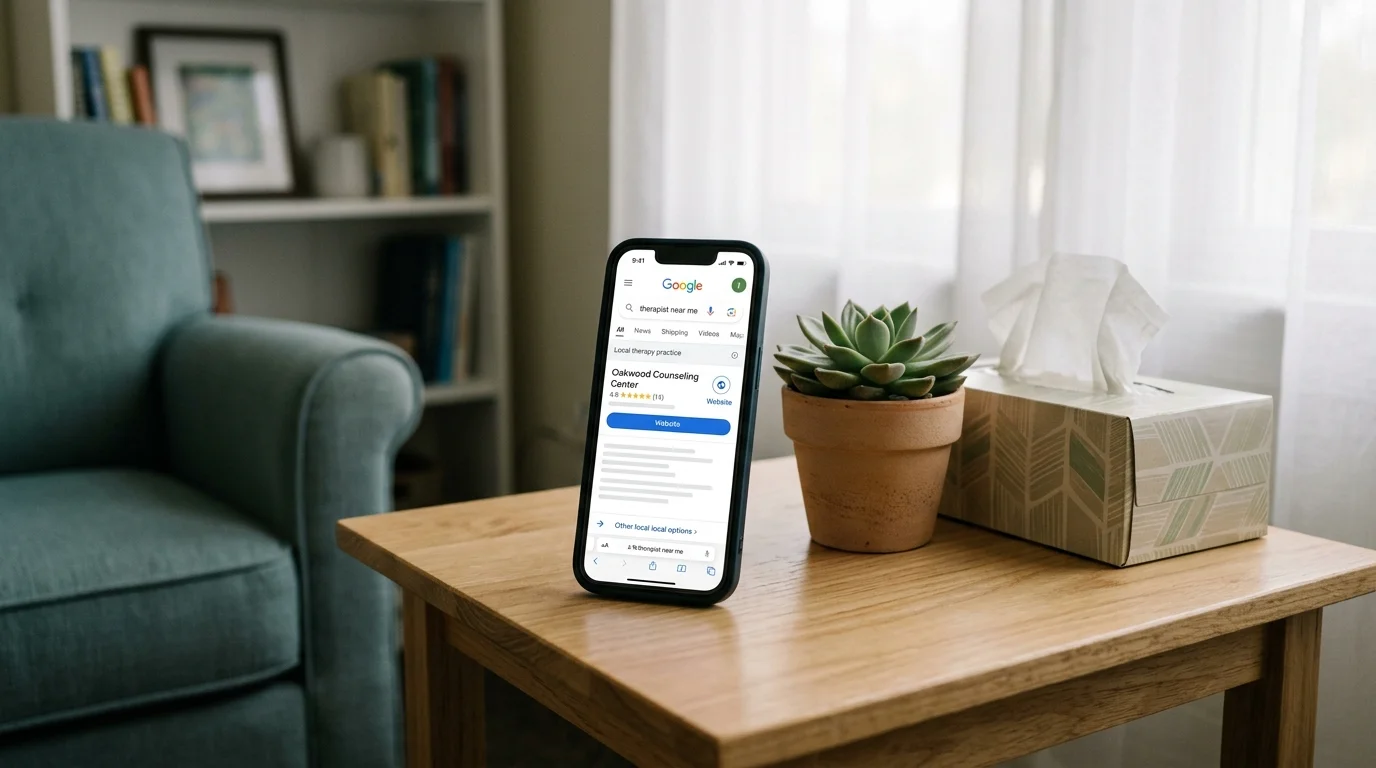
When someone searches "therapist near me" or "anxiety therapist [city]," they've already decided they need help. They're not browsing. They're looking for someone to call. If your practice shows up, you get that client. If it doesn't, someone else does.
Why Therapists Need SEO
Mental health awareness has driven a massive increase in people searching for therapy services online. According to the American Psychological Association, demand for mental health services has grown significantly in recent years, and most potential clients start their search on Google.
Most therapists rely on Psychology Today, GoodTherapy, or TherapyDen for client acquisition. These directories work. But your profile sits alongside dozens of competitors, and you have limited control over how you're presented. On your own website, you control the narrative: your approach, your specialties, your personality, your availability.
Therapy is also a high-lifetime-value service. A single ongoing client typically generates $4,000 to $10,000+ per year in session fees. One new weekly client from organic search can generate $150 to $250 per week for years. That makes SEO for therapists one of the highest-ROI investments a practice can make.
What Therapist SEO Actually Includes
Effective SEO for therapists requires strategies tailored to the sensitive, trust-driven nature of mental health services:
- Google Business Profile optimization: Your GBP listing drives "therapist near me" Map Pack visibility. Accurate categories (psychologist, counselor, marriage therapist, etc.), complete profiles, and regular updates signal to Google that your practice is active and relevant.
- Specialty-specific landing pages: Individual pages for each specialty: anxiety therapy, depression treatment, couples counseling, EMDR, trauma therapy, grief counseling. Each page targets the specific searches potential clients use, like "EMDR therapist [city]" or "couples counseling near me."
- YMYL compliance: Therapy websites fall under Google's "Your Money or Your Life" category, which means Google holds them to a higher standard. Displaying credentials, licenses, education, and professional affiliations is critical. According to Google's helpful content guidelines, expertise signals are weighted heavily for health-related content.
- Privacy-conscious review strategy: Reviews matter for rankings, but therapy requires sensitivity. Encourage reviews that speak to professionalism, office environment, and ease of scheduling rather than treatment details. Google reviews build trust without compromising client confidentiality.
- Content that builds trust: Blog posts and resource pages about common mental health topics (What to expect in therapy, signs of anxiety, how couples counseling works) serve two purposes: they rank for informational searches and they demonstrate your expertise to potential clients who are evaluating whether to reach out.
- Insurance and accessibility information: Clear pages listing accepted insurance, sliding scale options, and session formats (in-person, telehealth). These details are what potential clients search for after finding a therapist, "therapist that takes [insurance] [city]" is a real search with high conversion intent.
"Trust signals matter more in healthcare than any other vertical. For mental health professionals, Google's E-E-A-T guidelines mean your credentials, experience, and patient-centered content directly impact whether you rank."
Mike Blumenthal, Local Search Expert (Source: Near Media)
What Industry Benchmarks Show for Therapist SEO
Therapy practices that invest in local SEO typically see:
- Google Map Pack visibility for primary keywords within 8 to 12 weeks
- 40 to 100% increase in organic website traffic within 6 months
- 3 to 8 new client inquiries per month from organic search
- Reduced dependency on directory listings and referral networks
The clients who find you through Google search tend to be higher-converting than directory leads. They've already read your website, understand your approach, and chosen to contact you specifically rather than scrolling through a list of providers.
The ROI Math: Why Therapist SEO Pays for Itself
A therapy client typically pays $150 to $200 per session and attends weekly for 3 to 6 months minimum. That's $1,800 to $4,800 from the initial treatment course alone. Many clients continue for a year or longer, bringing lifetime value to $8,000 to $10,000+. Some clients return periodically for years, making the true lifetime value even higher.
If SEO costs $800 per month and generates 4 new client inquiries, and you convert 2 of them into weekly clients at $175 per session, those 2 clients generate $1,400 per month in session revenue. Your SEO investment pays for itself in the first month of those two client relationships. Every subsequent month of sessions is pure return on your marketing investment.
Compare this to Psychology Today's featured listing ($30/month) where you compete with dozens of other therapists, or paid ads at $5 to $15 per click where most visitors don't convert. SEO delivers exclusive leads. Someone who finds your website through Google, reads about your approach, and calls you is a fundamentally different lead than someone scrolling through a directory. They've already self-selected based on your specialties and your style. That means higher show rates for initial consultations and better long-term retention.
Common Mistakes Therapists Make With SEO
Psychology Today as the only online presence
Psychology Today is a useful directory, but it's not a marketing strategy. Your profile competes side-by-side with every other therapist in your area. You can't control how results are sorted, you can't add detailed content about your approach, and you're one scroll away from a dozen alternatives. Your own website gives potential clients an exclusive view of your practice. They read about you, your specialties, your approach, and your philosophy without competing profiles pulling their attention. Use Psychology Today as one channel, but build your own website as your primary online presence.
No specialty pages
Most therapist websites have a generic "Services" or "What I Treat" page that lists everything in a paragraph or bullet list. But potential clients search for specific problems: "anxiety therapist [city]," "couples counseling near me," "EMDR therapy [city]," "depression therapist [city]." Without dedicated pages for each specialty, you're invisible for these high-intent searches. Create individual pages for anxiety, depression, couples therapy, trauma/PTSD, grief, and any other specialties you practice. Each page should describe the issue, explain your treatment approach, and make it easy to schedule a consultation.
HIPAA-unclear content
Some therapist websites inadvertently include content that raises HIPAA concerns. Client testimonials, case study details (even anonymized), or language that implies specific treatment outcomes can create problems. Keep your content educational and informational. Focus on explaining conditions, treatment approaches, and what clients can expect from the therapeutic process. Avoid suggesting specific outcomes or sharing anything that could identify a patient, even indirectly.
No information about practical logistics
Potential clients searching for a therapist have practical questions: Do you accept my insurance? Do you offer telehealth? What are your hours? How do I schedule? If these answers are buried or missing, visitors leave. Create clear, easily findable pages for insurance/fees, telehealth availability, office location, and scheduling process. "Therapist that takes [insurance] near me" is a real search query with strong conversion intent.
DIY vs. Hiring: What You Can Do Yourself
Many foundational SEO tasks for therapists are free and manageable between client sessions. Here's the honest breakdown:
Do it yourself (free):
- Claim and optimize your Google Business Profile. Add your specialties, accepted insurance, telehealth availability, and a professional photo. Post weekly tips related to mental health topics you specialize in.
- Optimize your Psychology Today profile. Use all available fields, include your specialties as keywords, and write a compelling bio that speaks directly to potential clients' pain points rather than listing credentials.
- Write simple specialty pages on your website. Even a 300-word page about "Anxiety Therapy in [City]" that explains your approach can start ranking in smaller markets.
- Ask willing clients for Google reviews focused on professionalism, office environment, and scheduling ease. Never ask clients to discuss their treatment or diagnosis in a review.
Hire a professional for:
- Technical site audits (page speed, mobile optimization, healthcare schema markup)
- Keyword research covering specialty-based, condition-based, and insurance-based search queries
- Building optimized landing pages for each specialty and service area
- YMYL content strategy that meets Google's expertise standards for health-related content
- Local citation building on Healthgrades, GoodTherapy, TherapyDen, and psychology directories
The DIY steps can meaningfully improve your visibility, especially for Map Pack results. If you're in a competitive market with multiple practices investing in SEO, professional help is typically what gets you from page 3 to page 1. See our pricing and how we approach it.
How to Choose an SEO Provider for Your Therapy Practice
Mental health SEO has unique sensitivities that generic agencies often mishandle. Here's what to look for:
- They audit before they pitch. A provider who proposes a plan without analyzing your site, your specialties, and your local competition is selling a template. Demand an SEO audit with real data.
- They understand HIPAA considerations. Your SEO provider should know that client testimonials, case studies, and outcome claims require careful handling in mental health. Content should be educational and informational, never implying specific treatment results.
- They know YMYL requirements. Therapy websites fall under Google's "Your Money or Your Life" guidelines, which hold health content to a higher standard. Your provider needs to understand how E-E-A-T applies to mental health content and ensure your credentials, experience, and expertise are properly showcased.
- They don't guarantee #1 rankings. No one controls Google's algorithm, and YMYL content faces additional scrutiny. Ranking guarantees for healthcare content are especially unreliable.
- They publish their pricing. Transparency in business relationships matters. We publish ours.
Frequently Asked Questions
How much does SEO cost for a therapist?
Therapist SEO typically costs between $500 and $1,200 per month. Since ongoing therapy clients are worth $4,000 to $10,000 per year in session fees, even one new client per month from organic search delivers a strong return on investment.
How long does therapist SEO take to work?
Most therapy practices see improvements in local search visibility within 8 to 12 weeks. Organic rankings for terms like "therapist near me" or "[specialty] therapist [city]" typically improve within 3 to 6 months depending on your local competition.
Should therapists use Psychology Today or SEO?
Both, but they serve different roles. Psychology Today is a directory where you compete side-by-side with every other therapist. Your own website ranking on Google gives you an exclusive audience, visitors see only your practice, your approach, and your expertise. SEO also gives you control over your online presence that a third-party directory cannot.
What specialties should a therapist create pages for?
Start with the conditions that drive the most search volume: anxiety, depression, couples/marriage counseling, trauma and PTSD, and grief. Then add pages for your specific modalities (CBT, EMDR, DBT) and populations you serve (teens, LGBTQ+, veterans). Each page should target "[specialty] therapist [city]" keywords and explain your approach to treating that specific issue.
How should therapists handle reviews for SEO?
Reviews are critical for local rankings, but therapy requires sensitivity. Encourage clients to leave reviews about professionalism, office comfort, scheduling ease, and overall experience. Never ask clients to mention their diagnosis, treatment details, or outcomes. Some therapists include a note in their intake paperwork explaining that Google reviews help the practice and suggesting what types of feedback are appropriate to share publicly.
See how other healthcare providers approach SEO in our SEO for doctors guide, or find out what SEO costs.
Sources and References
- American Psychological Association. (2025). Growing Demand for Mental Health Services. apa.org
- Google. (2025). Creating Helpful Content. developers.google.com
Voxel Phase helps therapy practices get found on Google through local SEO audits, SEO-optimized websites, and content that ranks. Plans start at $588/month. Get your free SEO audit. We'll show you exactly where your practice stands in local search.