
SEO Blog Writing Services: What to Look For (And What to Avoid)
Last Updated: March 2026
You've decided you need blog content for SEO. Now you need someone to write it. A quick search for "SEO blog writing services" returns dozens of options ranging from $0.03 per word content mills to $500-per-post agencies. The price spread is enormous, and the quality gap is even wider.
This guide covers what separates a blog writing service that actually improves your rankings from one that just produces words. We'll walk through the specific features to look for, the red flags to avoid, and a framework for evaluating any service before you commit.
What Should an SEO Blog Writing Service Actually Include?
An SEO blog writing service should deliver more than words on a page. The writing itself is only one step in a process that starts with data and ends with measurement. Here's what a complete service includes, and what you should expect at each stage.
Before writing: the research phase
Every post should start with keyword cluster research, not a topic suggestion pulled from thin air. The service should identify a primary keyword, map secondary terms and related questions, and analyze the search intent behind the query. This research determines the content format, depth, and angle before a single word is written.
We covered this process step-by-step in our guide on how to write an SEO-friendly blog post. The short version: if a service skips the research phase, the content won't rank regardless of how well it's written.
During writing: SEO structure
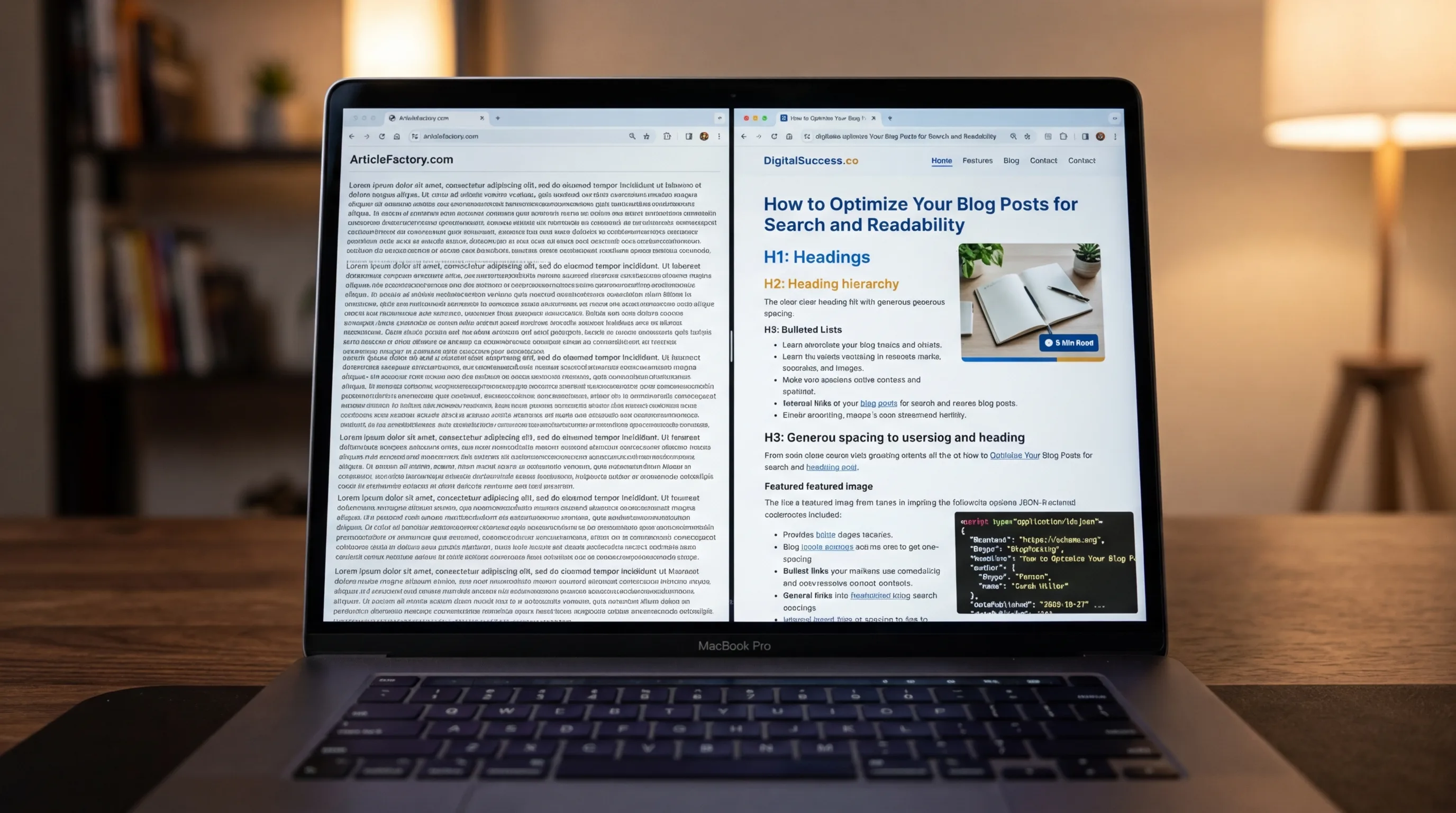
The content itself should include proper heading hierarchy (H1, H2, H3), a keyword-optimized meta title and description, short paragraphs, and natural keyword placement throughout. None of these are optional. They're the structural foundation that helps search engines understand what the content covers.
After writing: technical SEO elements
This is where most services fall short. A complete blog post should include:
- Article schema markup (structured data that tells Google the page is a blog post, including author, date, and headline)
- FAQ schema on posts that answer common questions (triggers rich results in Google)
- 3+ internal links with intent-matched anchor text (not "click here" or "read more")
- Rank tracking for at least 60 days after publication
According to Google's Article schema documentation, adding structured data helps Google understand the page and display it with enhanced features in search results. Most content mills and freelance writers skip schema entirely because it requires technical knowledge beyond writing.
Red Flags: Signs of a Bad Blog Writing Service
Not every service that calls itself "SEO blog writing" actually produces content that ranks. Here are the warning signs that a service is more content mill than SEO partner.
1. Per-word pricing
Pricing by the word incentivizes length, not quality. A writer paid $0.05 per word has every reason to pad sentences and add filler. A writer paid per post has every reason to make the post as effective as possible within the scope. Per-word pricing is the hallmark of content mills. Professional SEO blog writing services price by the post or by monthly retainer.
2. No keyword research process
If the service asks you to provide the keywords and just writes to them, they're a writing service, not an SEO blog writing service. The keyword research, search intent analysis, and competitive gap identification are the most valuable parts of the process. A service that skips them is selling you words without strategy.
3. AI-only content with no human review
AI-generated content now accounts for over 17% of content in Google's top 20 search results. But Google's helpful content guidelines specifically evaluate whether content demonstrates real experience and expertise. Google's quality raters now assess whether content is AI-generated, and the January 2025 guidelines update introduced a new section on "fake EEAT" content.
AI is a tool, not a replacement for human expertise. The best services use AI to accelerate research and drafting, then have human editors optimize for SEO, verify claims, add strategic elements (schema, linking, EEAT signals), and ensure the content matches the brand voice. Our blog writing service uses exactly this approach: AI-assisted drafting with expert human review.
4. No schema markup included
If the service delivers a blog post without Article schema, they're leaving SEO value on the table. Schema markup is a technical differentiator that most writers skip. If it's not explicitly listed as an included deliverable, assume it's not there.
5. Long-term contracts before proof of quality
Any service that requires a 6-12 month contract before you've seen a single post is betting that you won't cancel even if the quality is poor. Look for services that offer single-post trials or month-to-month packages. If the content performs, you'll stay. If it doesn't, you should be free to leave.
6. No revision process
Blog writing is collaborative. Your industry knowledge combined with SEO expertise produces the best content. A service with no revision rounds is telling you they don't want your input. At minimum, you should get one round of revisions on every post.
Green Flags: What Good Services Look Like
Here's what to look for in a service that will actually improve your search rankings over time.
| Green Flag | Why It Matters | Questions to Ask |
|---|---|---|
| Keyword research included | Content targets terms people actually search for | "How do you select target keywords?" |
| Search intent analysis | Content format matches what Google rewards | "How do you determine the right content format?" |
| Schema markup delivered | Posts can trigger rich results and AI citations | "Do you include Article and FAQ schema?" |
| Internal linking strategy | Builds topical authority across your site | "How many internal links per post and how do you choose anchors?" |
| Rank tracking included | You can measure whether the content works | "Do you track keyword rankings after publication?" |
| Transparent pricing | No hidden fees, you know what you're paying | "What's included at each price point?" |
| No long-term lock-in | The service earns your business monthly | "Can I start with a single post or trial?" |
How Much Should SEO Blog Writing Cost?
Pricing varies widely, and there's a reason. The quality and scope of what's included at each price point is fundamentally different.
Under $50 per post: content mills
At this price, you're getting volume, not strategy. The writer gets paid $15-30 per article after the platform takes its cut. There's no keyword research, no schema markup, no internal linking strategy, and minimal editing. The defining characteristic of a content mill is the emphasis on volume: quality, research, and proofreading are all sacrificed for speed. These posts rarely rank.
$50-150 per post: the middle ground
This range can deliver good value if the service includes keyword research and basic SEO optimization. At $39.95 per post, our SEO blog writing packages include keyword cluster research, schema markup, internal linking, meta tags, and a revision round. This price point works when AI-assisted workflows handle the first draft and human editors handle the strategic layer.
$200-500 per post: full-service agencies
At this level, you should expect dedicated strategists, multiple revision rounds, and comprehensive reporting. The content quality should be noticeably higher, with original research, expert interviews, and custom graphics. This range makes sense for competitive industries where a single ranking position is worth thousands in revenue.
$500+ per post: enterprise content
Enterprise pricing includes dedicated account managers, content strategy consulting, and integration with broader marketing campaigns. Unless you're in a highly competitive vertical (legal, finance, enterprise SaaS), this level of investment isn't necessary for blog content.
"Focus on who created the content, how it was produced, and most importantly, why it was created."
- Google, Creating Helpful Content Guidelines (source)
How to Evaluate a Blog Writing Service Before You Buy
Before committing to any service, run through this evaluation checklist. You can learn almost everything you need from a single conversation and one sample post.
Ask these five questions
- "Walk me through your process from keyword selection to published post." If the answer doesn't include keyword research, intent analysis, and post-publication tracking, the service is incomplete.
- "Can I see a sample post with schema markup?" This immediately separates professional services from basic writing shops. If they can't show you schema, they don't include it.
- "What happens if a post doesn't rank after 60 days?" A good service will have a process for this: reviewing the keyword targeting, adjusting the title, updating the content. A bad service won't track rankings at all.
- "Can I order a single post first?" Services confident in their quality will let you test before committing. Mandatory multi-month contracts are a sign the service relies on lock-in, not results.
- "How do you handle AI in your writing process?" Transparency about AI usage is a green flag. Denial of AI usage is a red flag (nearly every service uses it in some capacity). What matters is how they layer human expertise on top.
Evaluate the sample post
When you receive a sample or review their portfolio, check for these specific elements:
- Does the post target a specific keyword cluster, or is it generic?
- Is the heading structure clean (H1 > H2 > H3) with keywords in the headings?
- Are there internal links with descriptive anchor text?
- Do they cite sources for factual claims?
- Is there schema markup in the HTML?
- Does it have a meta title and description that would earn clicks?
If a post fails three or more of these checks, the service isn't delivering SEO content. It's delivering blog posts that happen to exist on the internet.
Why This Matters More in 2026
The bar for blog content that ranks keeps rising. Google's quality rater guidelines now specifically flag "fake EEAT" content and "scaled content abuse," which includes AI-generated content published with little effort or originality. The global content writing services market is projected to reach $38.6 billion by 2033, which signals that businesses are investing more in content quality because surface-level posts no longer compete.
Zero-click searches now account for roughly 60% of all Google searches, driven by featured snippets and AI Overviews. The posts that earn clicks from the remaining 40% need to be structured, sourced, and technically optimized. This means the gap between professional SEO blog writing and generic content production is widening. Businesses investing in the right service gain a compounding advantage. Those cutting corners with content mills fall further behind.
If you're evaluating blog writing services, start with a single post. See how it performs. Measure the process, not just the output. The right service pays for itself in organic traffic within 3-6 months. The wrong one is a recurring expense that produces nothing.
Sources and References
- Google. (2025). Creating Helpful, Reliable, People-First Content. developers.google.com
- Google. (2025). Article Structured Data. developers.google.com
- Google. (2022). E-A-T Gets an Extra E for Experience. developers.google.com
- Search Engine Land. (2025). Google Quality Raters Now Assess Whether Content Is AI-Generated. searchengineland.com
- Search Engine Journal. (2025). Google's Updated Raters Guidelines Target Fake EEAT Content. searchenginejournal.com
Voxel Phase provides SEO blog writing starting at $39.95 per post, with keyword cluster research, schema markup, internal linking, and 60-day rank tracking included. No contracts required. Also offering local SEO audits, content strategy, and SEO-optimized websites for small businesses in San Francisco, Oakland, the Bay Area, San Jose, and Sacramento. Order your first post and see the difference.