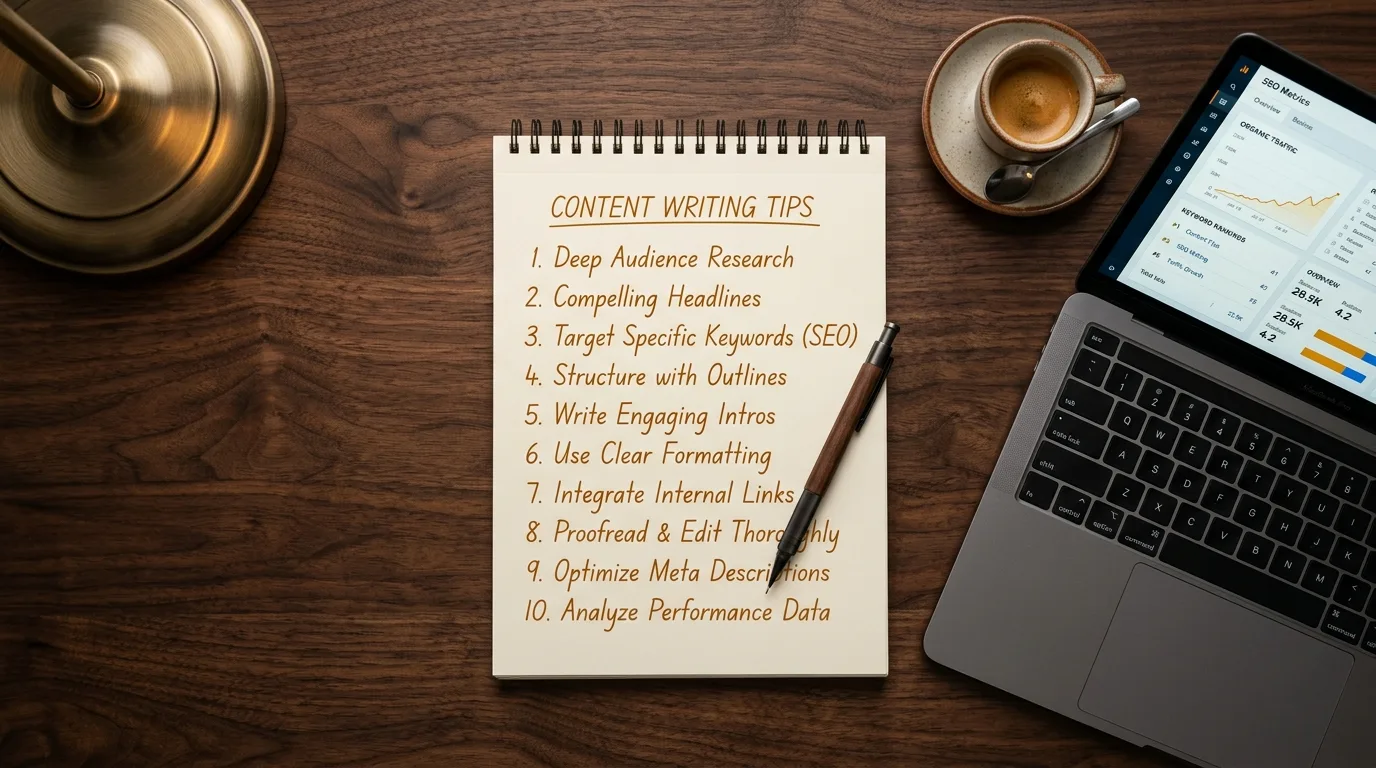
SEO Content Writing: The Complete Guide for 2026
Last Updated: March 2026
SEO content writing is not just "writing with keywords." It's a process that starts with data, follows a structure, and ends with measurement. Most content fails to rank because the writer treated SEO as an afterthought: write the article first, sprinkle in some keywords later, publish and hope.
That approach doesn't work in 2026. Google's algorithm evaluates over 200 ranking factors. AI search engines like ChatGPT, Perplexity, and Google's AI Overviews pull from content that's structured, sourced, and technically sound. The bar for content that earns organic traffic keeps rising.
This guide covers everything you need to know about SEO content writing: the research, the writing, the technical elements, and the measurement. Whether you're writing content yourself or evaluating a blog writing service, these are the fundamentals that determine whether content ranks.
What Is SEO Content Writing?
SEO content writing is the practice of creating web content that's designed to rank in search engine results for specific keywords. It combines traditional writing skills with technical optimization: keyword targeting, content structure, schema markup, internal linking, and performance tracking.
The goal is to create content that serves two audiences simultaneously: the human reader who needs useful information, and the search engine that needs to understand what the content covers and why it deserves to rank. Google's helpful content guidelines describe this as "people-first content," meaning content created primarily for people, not to manipulate search engine rankings.
Good SEO content writing achieves both. It answers the reader's question thoroughly while being structured in a way that search engines can parse, categorize, and rank.
Step 1: Keyword Research and Cluster Mapping
Every piece of SEO content starts with keyword research. Not a topic idea, not a brainstorm session, but actual data on what people search for, how often, and how competitive each term is.
Building a keyword cluster
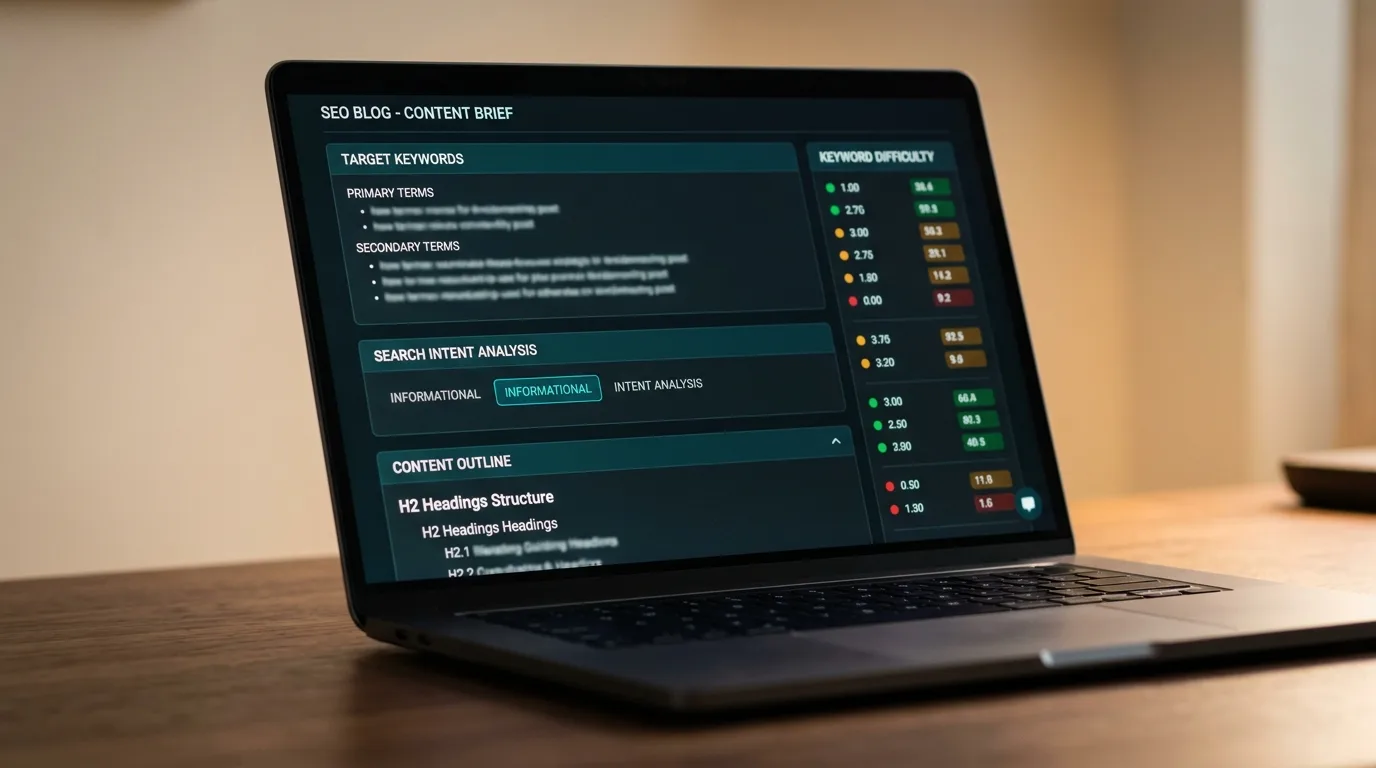
Modern SEO content doesn't target a single keyword. It targets a cluster: a group of related terms that share the same topic. A well-optimized blog post targets 8-15 terms across the cluster, giving search engines multiple signals about what the page covers.
A keyword cluster includes:
- Primary keyword: The main term you want to rank for (e.g., "seo content writing")
- Secondary keywords: Variations and synonyms ("content writing for seo," "writing seo content")
- Question keywords: What questions searchers ask ("how to write seo content," "what is seo content writing")
- Related subtopics: Concepts that naturally belong in comprehensive coverage (schema markup, internal linking, search intent)
We walk through the full cluster-building process in our guide on how to write an SEO-friendly blog post.
Keyword difficulty and realistic targeting
Every keyword has a difficulty score (KD) that estimates how hard it is to rank in the top 10. New sites should target KD under 20. Established sites can target KD 20-40. Anything above 40 requires significant domain authority. An analysis of over 250,000 search results found that topical authority is now the strongest on-page ranking factor, even surpassing domain traffic. This means building a cluster of related content on one topic is more effective than publishing scattered posts across unrelated topics.
Step 2: Search Intent Analysis
Search intent is the reason behind a query. It determines what format, depth, and angle your content needs. A page that doesn't match the searcher's intent won't rank, regardless of keyword optimization.
The four intent types:
| Intent | What the Searcher Wants | Best Content Format |
|---|---|---|
| Informational | Learn or understand something | How-to guide, explainer, tutorial |
| Commercial | Compare options before a decision | Comparison, buyer's guide, review |
| Transactional | Take a specific action | Product page, service page, pricing |
| Navigational | Find a specific website or page | Brand page, homepage |
The simplest way to check intent: Google your target keyword and study the top 5 results. Whatever format dominates page one is what Google has determined matches the intent. Your content should follow the same format, then do it better.
Step 3: Content Structure and On-Page SEO
The way content is structured matters as much as the words themselves. Search engines use heading hierarchy, paragraph structure, and keyword placement to understand what a page covers.
Heading hierarchy
Use one H1 (the title), H2s for main sections, and H3s for subsections. Nearly 100% of page-one results include the target keyword in the title or H1. Place your primary keyword in the H1 and at least one H2. Secondary keywords work well in other H2s and H3s.
Keyword placement
A study analyzing over 1,500 Google search results found no consistent correlation between keyword density and ranking. Pages in the top 10 today have a 50% lower keyword density than those ranking a couple of years ago. What matters is placing keywords where they naturally belong: titles, headings, and early context. Write for the reader, not for a keyword density tool.
Paragraph and sentence structure
Online readers scan, they don't read linearly. Keep paragraphs to 2-4 sentences. Lead with the most important information. Use short sentences (under 20 words on average). When it comes to AI search citations, content depth and readability matter most, while traditional metrics like backlinks have less impact.
Meta title and description
Your meta title should include the primary keyword and be under 60 characters. The meta description should summarize the content in 150-160 characters with a reason to click. Position 1 on Google gets a 39.8% click-through rate. Position 3 drops to 10.2%. A strong meta title directly affects how much traffic your ranking actually delivers.
Step 4: E-E-A-T Signals
E-E-A-T stands for Experience, Expertise, Authoritativeness, and Trustworthiness. Google's quality rater guidelines use E-E-A-T to evaluate content quality. Of these four aspects, Google states that trust is the most important.
How to demonstrate E-E-A-T in your content
- Experience: Show first-hand knowledge. If you're writing about SEO, demonstrate that you've actually done SEO work. Case studies, specific examples, and process descriptions signal real experience.
- Expertise: Back up claims with sources. Link to authoritative references. Use data, not opinions, to support your points.
- Authoritativeness: Publish under a named author with credentials. Link to an author page. Build a body of content on your topic area.
- Trustworthiness: Be transparent about who's behind the content. Provide contact information. Maintain a positive online reputation. Don't make claims you can't support.
For YMYL (Your Money or Your Life) topics, which include any business where customers make financial decisions, E-E-A-T signals are especially critical. If your service pages or blog posts read like they were written by someone who's never done the work, Google notices.
"People-first content means content that's created primarily for people, and not to manipulate search engine rankings."
- Google, Creating Helpful Content (source)
Step 5: Schema Markup
Schema markup is structured data you add to your content's HTML that helps search engines understand exactly what the page is. It doesn't change what readers see, but it changes how search engines interpret and display your content.
For blog content, the essential schema types are:
- Article or BlogPosting schema: Includes headline, author, datePublished, dateModified, and featured image
- FAQ schema: Triggers expandable question-and-answer rich results in Google
- HowTo schema: For step-by-step content, triggers special formatting in search results
According to Google's Article schema documentation, adding structured data helps Google understand the page and show it with enhanced features in search results. Schema also plays a growing role in AI search visibility. AI engines use structured data to identify entities, relationships, and factual claims. Content with clean schema markup is easier for these systems to parse, cite, and recommend.
Most content writers skip schema because it requires technical knowledge. It's one of the clearest differentiators between amateur and professional SEO content. We include schema on every post in our blog writing service. Our guide on SEO blog writing tools covers which tools make schema generation straightforward.
Step 6: Internal Linking Strategy
Internal links connect your content to other pages on your site. They distribute ranking power, help Google discover new content, and build the topical authority that search engines use to determine which sites deserve to rank.
A study of 2.5 million internal links across 1,700 websites found that articles with 3+ contextual internal links and varied anchor text saw a 30% increase in organic traffic. The quality of links matters more than quantity.
Internal linking best practices
- Use intent-matched anchor text: The clickable text should describe what the reader will find. "SEO content strategy" is better than "click here."
- Link where it's contextually relevant: The link should appear where a reader would naturally want to learn more about the topic.
- Build hub-and-spoke structures: Pillar pages (service pages, comprehensive guides) should receive the most internal links. Supporting content links to the pillar, and the pillar links back.
We covered the most common mistakes in our post on the internal linking mistake most small business websites make. The short version: random links with generic anchors waste the SEO value that strategic linking delivers.
Step 7: AI Search Optimization
SEO content writing in 2026 needs to account for AI search engines. Over 100 million people use ChatGPT monthly. Perplexity is growing as a Google alternative. Google's AI Overviews appear on a significant percentage of search results. Zero-click searches now account for roughly 60% of all Google queries.
What helps content get cited by AI engines:
- Self-contained sections: Each H2 section should stand alone. AI engines extract individual sections, not entire articles.
- Source-backed claims: Content with verifiable citations has higher selection probability in AI responses.
- Structured data: Schema markup helps AI engines identify entities and factual claims.
- Freshness signals: AI engines prioritize recent content. Include a visible "Last Updated" date and use current-year data.
For a deeper dive, see our guide on how to rank in AI search and our answer engine optimization services.

Step 8: Publish and Track Performance
Publishing is the starting point for measurement, not the finish line. A newly published blog post typically takes 2-4 months to settle into its ranking position for low-competition keywords. Higher competition terms take 4-8 months.
What to track
- Keyword rankings: Which keywords is the page appearing for? What positions? Climbing or stagnant?
- Organic traffic: How many visitors from search? Trending up?
- Click-through rate: Are people clicking when they see your result?
- Engagement: Time on page, pages per session, bounce rate
Google Search Console provides this data for free. Check at 30 days and again at 60 days. If a post isn't gaining traction after 60 days, review the keyword targeting and search intent alignment. Sometimes a small title adjustment or restructured introduction is all it takes. Our guide to SEO writing tools covers the best free and paid options for rank tracking.
The Compounding Effect of Consistent SEO Content
A single well-optimized post can rank and drive traffic for years. But the real power of SEO content writing comes from consistency. Each post adds another indexed page, targets another keyword cluster, and creates more internal linking opportunities. Over time, this builds topical authority.
Two posts per month is a minimum for building momentum. Four posts per month is where topical authority starts compounding. At eight posts per month with pillar-and-cluster architecture, you can dominate a niche within 6-12 months.
If you have the expertise but not the bandwidth, or if the technical elements (schema, internal linking, rank tracking) are outside your skill set, that's where a professional SEO content writing service fits. We follow this exact process for every post, starting at $39.95.
Sources and References
- Google. (2025). Creating Helpful, Reliable, People-First Content. developers.google.com
- Google. (2022). E-A-T Gets an Extra E for Experience. developers.google.com
- Google. (2025). Article Structured Data. developers.google.com
- Google. (2023). Google Search's Guidance About AI-Generated Content. developers.google.com
- Google. (2024). SEO Starter Guide: The Basics. developers.google.com
- LinkStorm. (2025). 2.5 Million Internal Links Study. linkstorm.io
- Search Engine Land. (2025). E-E-A-T: Making Experience and Expertise Your Content Advantage. searchengineland.com
Voxel Phase provides SEO content writing starting at $39.95 per post, with keyword cluster research, schema markup, internal linking, and 60-day rank tracking included. Also offering local SEO audits, content strategy, and SEO-optimized websites for small businesses in San Francisco, Oakland, the Bay Area, San Jose, and Sacramento. Order your first post.