SEO for Dentists: 8 Steps to Fill Your Appointment Book From Google
You paid a dental web design company to build your website. It has a stock photo of a smiling family, a list of services, and your office hours. It looks professional. And when someone in your city searches "dentist near me," you're on page four, behind two corporate chains, a dentist who's been retired for three years, and a Yelp listing with outdated information. SEO for dentists fixes this, and it's more straightforward than most agencies want you to believe.
Dental practices have a specific SEO problem: the companies that build dental websites, RevenueWell, Officite, ProSites, understand dental practice management. They build patient portals and online scheduling. What they typically don't build is a website that ranks on Google.
This guide walks through every step of dental SEO, in the order that produces results fastest. If your practice website isn't showing up at all, start with our guide on why websites don't show up on Google, then come back here for dental-specific strategies.

Why Most Dental Websites Fail at SEO
The dental web design industry has a template problem. Most practices end up with a site that looks like every other dental site: same stock photos, same vague service descriptions, same "Welcome to Our Practice" headline. Google sees hundreds of nearly identical dental sites in every metro area and has no reason to rank yours above any of them.
Here's what a thorough SEO audit typically uncovers on a dental practice website:
- No keyword targeting. The homepage title tag says "Welcome to [Practice Name]" instead of "Dentist in [City] | [Practice Name]."
- One generic services page instead of individual pages for cleanings, crowns, implants, emergency care, and cosmetic procedures.
- Slow load times. Bloated templates with uncompressed images and third-party scripts that push load times past 5 seconds on mobile.
- No schema markup. Google doesn't know you're a dental clinic, what services you offer, or what insurance you accept.
- Zero local signals. No city or neighborhood mentions in the content. No embedded map. No connection between the website and the Google Business Profile.
Small business websites typically have around 40-50 technical issues. Dental websites tend to hit that number or higher because of rigid templates and design-first (not search-first) development.
1. SEO for Dentists Starts With Google Business Profile
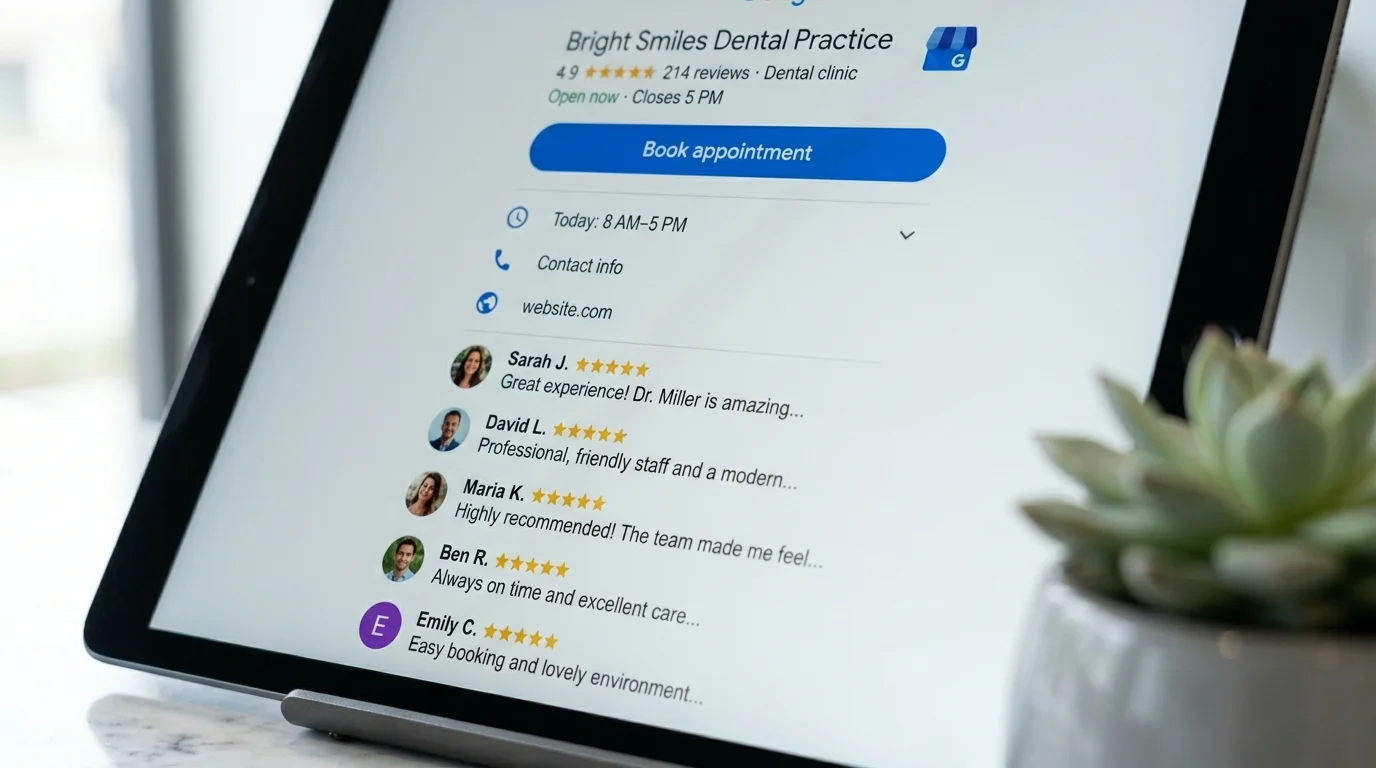
If your dental practice does one thing from this entire guide, make it this. Your Google Business Profile controls whether you show up in the Map Pack. The three local results at the top of the page when someone searches "dentist near me" or "dentist [city]." Those three listings capture over 40% of all local search clicks.
According to BrightLocal's research, roughly 70% of local businesses have incomplete Google Business Profiles. For dental practices, this means a fully optimized GBP is an immediate competitive advantage over most of your neighbors.
Here's what a fully optimized dental GBP looks like:
- Primary category: "Dentist." Not "Medical Clinic." Not "Health & Wellness." According to Whitespark's Local Search Ranking Factors study, primary category is consistently the top-weighted GBP ranking signal. If you're a pediatric dentist, use "Pediatric Dentist." If you're an orthodontist, use "Orthodontist." The more specific, the better.
- Secondary categories: Add every relevant one, "Cosmetic Dentist," "Emergency Dental Service," "Dental Implants Provider," "Teeth Whitening Service." You can add up to 10.
- Photos: 15–25 photos minimum. Your office exterior (so patients recognize the building), reception area, treatment rooms, your team, and your equipment. Skip the stock photos, real photos of your actual practice outperform generic imagery.
- Services list: Add every procedure you perform. Google uses this data to match your profile to specific searches like "dental implants near me" or "Invisalign [city]."
- Insurance information: List every plan you accept. "Dentist that takes Delta Dental" and "dentist that accepts Medi-Cal" are real search queries with real volume.
- Google Posts: Publish weekly. Seasonal tips (back-to-school checkups, holiday candy warnings), new service announcements, team introductions. Posts signal to Google that your profile is actively managed.
- Q&A section: Seed it yourself. "Do you accept walk-ins?" "Do you offer sedation dentistry?" "Is parking available?" Answer before someone else does.
GBP optimization alone can increase patient calls by 35–50%. It's also the fastest to show results. Most practices see improvements within 4–8 weeks.
2. Target the Keywords Dental Patients Actually Search
Patients don't search the way dentists talk. You think "periodontal scaling and root planing". They search "deep cleaning cost." You write "endodontic therapy". They search "root canal near me."
Dental keyword research means bridging that gap. The highest-value keywords for dental practices follow predictable patterns:
- "Dentist" + city: "dentist San Mateo," "dentist Walnut Creek," "dentist Fremont"
- "Dentist near me": This single phrase gets over 1.2 million monthly searches nationally
- Procedure + city: "dental implants Oakland," "Invisalign San Jose," "teeth whitening Palo Alto"
- Cost queries: "how much do dental implants cost," "teeth cleaning cost without insurance," "Invisalign cost Bay Area"
- Emergency searches: "emergency dentist near me," "broken tooth what to do," "dentist open Saturday [city]"
- Insurance queries: "dentist that takes Delta Dental near me," "Medi-Cal dentist [city]"
Each keyword type maps to a specific page on your website. Your homepage targets "dentist [city]." Individual service pages target "dental implants [city]" or "teeth whitening [city]." Blog posts target question-based searches. We build this out as part of our content creation process.
3. Fix the Technical Problems Killing Your Rankings
A dental SEO strategy built on a broken website is a waste of money. Technical problems are often invisible to practice owners, the site looks fine to you, but Google sees something different.
Page Speed
Most dental websites load in 5–8 seconds on mobile. Google wants under 3 seconds. The culprits are almost always the same: uncompressed images (that hero photo of your office is 4MB when it should be 200KB), too many third-party scripts (live chat widgets, analytics trackers, social media embeds), and cheap shared hosting picked by whichever company built your site.
Test yours at PageSpeed Insights. If your mobile score is under 50, you have work to do. According to Google's Core Web Vitals documentation, page experience is a confirmed ranking signal.
Mobile Usability
Over 60% of "dentist near me" searches happen on phones. Google uses mobile-first indexing. If your site is hard to use on a phone, it barely exists to Google. Common dental website problems: tap targets too small (tiny phone numbers that are impossible to click), text too small to read without zooming, and menus that don't work on mobile.
HTTPS
If your dental website still loads on http:// instead of https://, fix that today. It's a basic trust signal, and Google has used it as a ranking factor since 2014. Most hosting providers offer free SSL certificates.
If your website needs more than just fixes. If it needs a complete rebuild to support proper SEO, our website building service handles the technical foundation so your dental SEO has room to work.
4. Build Citations on Dental Directories
Citations are mentions of your practice's name, address, and phone number (NAP) across the web. Google uses them to verify that your practice is real, that your information is accurate, and that you're a legitimate business in your claimed location.
For dental practices, the directories that matter most:
- Healthgrades: Claim your profile. Add photos, update specialties, respond to reviews. This is one of the strongest citation sources for healthcare providers.
- Zocdoc: If you accept online booking, this doubles as both a patient acquisition channel and a strong citation. Worth the investment for most practices.
- 1-800-Dentist / DentistFinder: Dental-specific directories that Google trusts as industry sources.
- Yelp: Still a significant citation source. Claim, complete your profile, and respond to reviews.
- Vitals: Often auto-generated. Claim and correct any errors.
- Your state dental board listing: Make sure the address matches your GBP exactly.
- Your local Chamber of Commerce: A high-authority local link and citation in one.
The critical rule: your practice name, address, and phone number must be identical everywhere. "123 Main St" on Google and "123 Main Street" on Healthgrades counts as an inconsistency. Audit every listing and standardize. According to Whitespark's Local Search Ranking Factors research, citation consistency is a key local ranking signal.
5. Create Pages for Every Procedure You Offer
This is where most dental websites fall short. Instead of one generic "Services" page that lists everything you do, you need individual pages for each procedure, and each page needs to target a specific keyword.
A dental practice offering standard services should have dedicated pages for:
- Teeth cleaning and preventive care
- Dental implants
- Crowns and bridges
- Root canal treatment
- Teeth whitening
- Invisalign / clear aligners
- Emergency dental care
- Pediatric dentistry (if applicable)
- Cosmetic dentistry
- Dentures and partials
Each page should be 500–800 words of specific, useful information: what the procedure involves, who it's for, how long it takes, what recovery looks like, and what it costs (even a range helps). Include your city name naturally in the page title and body text.
A page titled "Dental Implants in Walnut Creek: What to Expect and What They Cost" targets a real search with real intent. A page titled "Our Services" targets nothing.
"Primary category is, and has always been, the most impactful Google Business Profile ranking factor. If you set your primary category to something broad like 'medical clinic' instead of your specific specialty, you are leaving rankings on the table."
- Darren Shaw, Founder, Whitespark (source)
Shaw's point applies directly to dental practices. "Dentist" as your primary GBP category outperforms "Medical Clinic" or "Health & Wellness." And if you specialize, pediatric dentistry, orthodontics, oral surgery, use the specific category.
6. Build a Review Strategy That Works for Dental Practices
Google reviews directly affect your Map Pack ranking. Practices with more reviews and higher average ratings show up higher. For dentists, reviews carry extra weight because patients are making a trust-based decision about who puts sharp instruments in their mouth.
According to BrightLocal's Local Consumer Review Survey, the majority of consumers read online reviews before choosing a local business, and healthcare is one of the categories where reviews matter most.
Here's what works for dental practices without feeling pushy:
- Ask after positive experiences. After a successful cleaning, whitening, or follow-up visit: when the patient is happy. Not after a root canal or a difficult procedure.
- Automate the ask. A text message 2–3 hours after their appointment with a direct link to your Google review page. One message, one link. You can automate review requests so your front desk doesn't have to remember.
- Make it one tap. Generate your Google review short link and include it in follow-up texts, emails, and appointment reminders. Every extra step loses people.
- Respond to every review. Thank positive reviewers by name. Address negative reviews professionally and offer to resolve things offline. Never argue publicly. Never reveal patient information.
- Never incentivize reviews. No discounts, no free whitening, no raffle entries. Google prohibits incentivized reviews and can penalize your profile.
Most dental practices can go from 20 reviews to 75+ within four months by asking consistently. The ranking difference between a practice with 20 reviews and one with 75 is substantial.
7. Add Dental Schema Markup to Your Website
Schema markup is structured data you add to your website's code that tells Google exactly what your practice is, where it's located, and what you do. Most dental websites have zero schema markup, which means adding it puts you ahead of nearly every local competitor.
For dental practices, the relevant schema types are:
- Dentist (a subtype of MedicalBusiness). Your practice name, address, phone, hours, accepted insurance, and available services
- Physician: Individual dentist profiles with credentials, specialties, education, and affiliations
- MedicalProcedure: On procedure pages, linking to standardized medical terminology
- FAQPage: On any page with questions and answers (can trigger FAQ rich results in Google)
- Review: Aggregate rating markup that can display star ratings in search results
This is technical work. Your developer or SEO agency handles it. But ask about it, because it's one of those things that takes a few hours to implement and gives you an edge for years.
"Structured data helps us to better understand the content on a page. That's one of the things that we use to understand what the page is about, and to show it appropriately in search results."
- John Mueller, Search Advocate, Google (source)
When your competitors' websites tell Google "this is a webpage," and yours tells Google "this is a dental clinic in San Mateo that offers implants, accepts Delta Dental, is open until 6pm on Thursdays, and has a 4.8 rating from 127 reviews". You win the information game.
8. Publish Content That Answers Patient Questions
Dentists are sitting on an unfair content advantage and almost none of them use it. You answer the same patient questions every day. Those exact questions are what people type into Google before they book an appointment.
A dental practice blog should target the questions patients actually ask:
- "How much do dental implants cost?"
- "Does teeth whitening damage enamel?"
- "How long does Invisalign take?"
- "What to do for a toothache at night"
- "Is a dental crown worth it?"
- "When should my child first see a dentist?"
- "Difference between a crown and a veneer"
Each of these is a real search with real volume. Each blog post that answers one of these questions is a chance to appear in Google's results and bring a potential patient to your website. Two to four posts per month is enough to build meaningful traffic over six months.
The content doesn't need to be long. 800–1,200 words that directly answer the question, written by (or at least reviewed by) an actual dentist. Google's E-E-A-T framework values first-hand experience, a blog post about dental implants written by someone who places them weekly carries more weight than one written by a marketing intern who Googled it.
If you're looking for help building out this kind of keyword-targeted content, that's a core part of what we do.
The ROI of SEO for Dental Practices
Here's the math that makes dental SEO a straightforward business decision.
Industry benchmarks show that SEO delivers new patients at $40–60 each. Direct mail, the traditional dental marketing workhorse, runs $150–250 per new patient. Google Ads for dental keywords cost $5–15 per click, with 10–15 clicks needed per booked appointment. That's $50–225 per patient from ads, with zero compounding.
SEO compounds. A page that ranks for "dental implants [your city]" sends you patients this month, next month, and next year, with no additional spend on that keyword. A direct mail piece goes in the recycling bin on the same day it arrives.
For a typical dental practice, two new patients per month from search covers the cost of an entire SEO program. At an average patient lifetime value of $1,000–$5,000 (depending on the mix of preventive care, restorative work, and cosmetic procedures), the return on a $788/month SEO investment is substantial.
If your medical practice is interested in SEO more broadly, our guide on SEO for doctors covers strategies that apply across healthcare specialties.
Where to Start With Dental SEO
If your practice has done zero SEO work, here's the priority sequence:
- Claim and fully optimize your Google Business Profile. Biggest impact, fastest results. Four to eight weeks to see changes.
- Get a technical SEO audit. Find out what's broken before you start building. Our audits cover 200+ ranking factors.
- Fix critical technical issues. Page speed, mobile usability, HTTPS, broken links.
- Build out procedure pages. One page per service, keyword-targeted, with your city name.
- Start a review generation system. Consistent, automated follow-up after appointments.
- Claim and standardize dental directory citations. Healthgrades, Zocdoc, Yelp, 1-800-Dentist.
- Add schema markup. Dentist and Physician types at minimum.
- Begin regular content publishing. Two to four blog posts per month answering patient questions.
Steps 1–3 should happen in month one. Steps 4–8 build over months two through six. By month six, most practices see measurable ranking improvements and a steady increase in patient inquiries from search.
Frequently Asked Questions
How much does SEO cost for a dental practice?
Most dental practices invest $500 to $1,500 per month for effective SEO. At that range you get technical optimization, Google Business Profile management, content creation, and local citation building. Our plans start at $588/mo. One or two new patients per month from search typically covers the entire cost.
How long does dental SEO take to show results?
Google Business Profile optimizations often show results in 4–8 weeks. Website ranking improvements for keywords like "dentist near me" typically take 3–6 months. Content-driven rankings for specific procedures build over 6–12 months of consistent publishing.
What is the most important SEO factor for dentists?
Your Google Business Profile. It controls whether you appear in the Map Pack. The three local listings at the top of Google that capture over 40% of local clicks. A fully optimized GBP with the right primary category, photos, and reviews is the fastest path to visibility.
Can I do dental SEO myself?
You can handle the basics: claiming your Google Business Profile, asking patients for reviews, keeping your directory listings accurate. But technical optimization, keyword-targeted content, and schema markup require SEO expertise. Most dentists find the 10–15 hours per month of proper SEO work is better spent seeing patients.
Do Google reviews affect dental practice rankings?
Yes. Review quantity, quality, and recency are confirmed local ranking factors. Practices with more reviews and higher ratings rank higher in the Map Pack. Responding to every review, positive and negative, also signals to Google that your profile is actively managed.
Get a Free SEO Audit for Your Dental Practice
We'll analyze your website, Google Business Profile, local citations, and search visibility before we even get on a call. When we talk, we'll be looking at real data about your specific practice. Not a generic sales pitch. See our full dentist SEO service page for details on what we cover.
Request your free audit here. It takes 30 seconds and there's no commitment. Here's how our process works.
Sources and References
- Google. (2025). Creating Helpful Content. developers.google.com
- Google. (2025). Core Web Vitals Documentation. developers.google.com
- BrightLocal. (2025). Local Consumer Review Survey. brightlocal.com
- Whitespark. (2025). Local Search Ranking Factors. whitespark.ca
- Schema.org. MedicalBusiness Schema. schema.org
- Healthgrades. Find a Dentist. healthgrades.com
- Zocdoc. Find a Dentist. zocdoc.com
Voxel Phase provides dentist SEO services, 200+ factor SEO audits, and content strategy for dental practices in San Francisco, San Jose, the Bay Area, and across California. See our pricing or schedule a free audit.